Showing posts with label George Baresch. Show all posts

Thursday, 24 July 2008

"Voynich Manuscript": two words, two lies?

Note: this article has now moved to voynich-manuscript-two-words-two-lies on Cipher Mysteries

While writing my MBA dissertation a few years ago, I spun off a short paper called "Justified True Belief: Three Words, Three Lies?", where the abstract explained its title:-
Cornelius Castoriadis once famously described the Union of Soviet Socialist Republics as “four words, four lies”: here, I examine each of the three words of “justified true belief” in turn to see if that too might be based on a fatally flawed discourse. In fact, “three lies” turns out to be a little strong - but the evidence strongly points to “two-and-a-half lies”. We deserve better than this!

My guess is that Castoriadis, for all his pithiness, was ripping off Voltaire, who in 1756 wrote:
This agglomeration which was called and still calls itself the Holy Roman Empire was neither Holy, nor Roman, nor an empire.

So now, by applying the same pattern to the Voynich Manuscript, I'm extending the chain of ripping yet further. Just so you know!

What's in a name? Wilfrid Voynich never called it "The Voynich Manuscript": right from the start, he called it "The Roger Bacon Manuscript". Which was a bit of a shame, given that it originally almost certainly had nothing to do with Roger Bacon.

However, because Voynich desperately wanted it to contain Bacon's encrypted secrets, he was convinced it had to be medieval. It was in this context that he referred to it as a "manuscript", because manuscripts are technically defined as being handwritten documents that predate the start of printing, which means 1450 or so. And so you can see that the word "Manuscript" in "Voynich Manuscript" presupposes a medieval document, or else it would have to be called "an early modern handwritten document" (which, for all its precision, is not quite so punchy). And worse, the range of dates it could sensibly have been made goes over this 1450 mark, so we have no real certainty to work from here.

As for "Voynich": in one sense it should be "Wojnicz", the book dealer's surname before he ended up in London. But we sophisticated moderns should perhaps more sensibly name it after the Jesuit Villa Mondragone (where Wilfrid Voynich found it), or Johannes Marcus Marci (who inherited it and whose letter to Kircher travelled with it all the way to New Haven), or George Baresch (arguably the first obsessive Voynich researcher to be documented), or Sinapius / de Tepenecz (whose erased signature still faintly remains on the first page), or even Holy Roman Emperor Rudolph II (who was said to have paid well for it).

All of this still rather panders to an implied need for naming, as if by giving it a name it somehow helps us understand its origins (it doesn't, can't, and won't). It's an itch we don't actually need to scratch: we need to learn to be more comfortable about remaining in a state of uncertainty.

My dissertation was all about knowledge and uncertainty: the work I've done since then points to my own three-word definition for knowledge - "hopefully useful lies". Calling this enigmatic object the "Voynich Manuscript" is indeed "two words, two lies" - but as long as we never forget that they are both lies, its name is a most useful tool.

Saturday, 19 July 2008

Czech Voynich theory...

Note: this article has now moved to czech-voynich-theory on Cipher Mysteries

My fellow Voynich old-timer Jan Hurych has long been interested in various Prague-linked research strands: after all, Prague was home to the first three properly-documented owners of the Voynich Manuscript (Sinapius, Georg Baresch, and Johannes Marcus Marci), as well as its most illustrious claimed owner (Holy Roman Emperor Rudolph II).

It is certainly true that Rudolph's interests and obsessions acted as a powerful magnet to draw wonders from all over Europe to his court. Yet given that the claimed link with John Dee and Edward Kelley is gossamer-thin, it is no less sensible to wonder whether the VMs had been brought to Prague by someone from the town: perhaps someone well-travelled?

I mentioned Rudolph II's manuscript-collecting astronomer / astrologer / herbalist / physician Tadeás Hájek here recently (who studied in Italy), but Jan Hurych regales me with tales of several others: for one, Hájek's father (Simon Baccalareus) studied alchemy and collected manuscripts... though what happened to his library after his death is not currently known.

Jan has put together a nice page on one of his favourite Renaissance Czech travelling knights, Krystof Harant de Polzic and Bezdruzic, and his travels from Venice to Crete to Cyprus to the Holy Land to Egypt (etc). But I have to say that if a writer had picked up an intriguing cipher manuscript on their travels, it would be one of the first things they would write about: yet there is no mention. So we can probably rule Harant out, sorry Jan. :-(

But Jan brings up a rather more full-on Czech Voynich theory, courtesy of Karel Dudek's Czech webpage (though I used Google Translate, Dudek also put up his own English translation here). Dudek discusses Georg Handsch of Limuz (1529-1578), whose 1563 German translation of Matthioli's Latin herbal came out a year after Tadeás Hájek's Czech translation (it even used the same nice woodcuts!) Like Hájek, Handsch was a physician living in Prague, but whose main client was instead Ferdinand II Tyrolský (1529-1595) and his wealthy wife Filipina Welserová (1527-1580).

Dudek got his information from Leopold Selfender's "Handsch Georg von Limuz - Lebensbild a Arztes aus dem XVI.Jahrenhunderts": but after a bit of a false start (linking Handsch directly to Baresch, which I doubt would convince anyone), he proposes a possible chain of ownership from Handsch -> Welserová -> Ferdinand II Tyrolský -> Rudolph II -> Horcicky (Sinapius), before Horcicky's estate got looted in the chaos of 1618 and the manuscript somehow ended up with Baresch (with the signature erased).

OK... but why Handsch? Dudek points to the VMs' botany, and Handsch's translation of Matthioli's herbal (though I'd have to say that Hájek fits that bill even better). Dudek also discusses a book by Handsch based on his trips to visit medicinal baths and spas in 1571 called "Die Elbfischerei in Bohmen und Meissen" (eventually published in Prague in 1933), and sees parallels with the VMs' water section there.

But Dudek gets even more speculative, talking about whether Bartoloměj Welser was financed by Charles V to undertake a (possibly Lutheran?) mission to South America, and drew pictures inspired by exotic plants he saw beside the Orinoco (hey, I thought he was a Womble?)

It's a good story, but a little lacking in connection to the VMs: and doesn't really explain why we see (for example) 15th century handwriting in the quire numbers, or even the Occitan-like month names on the zodiac, etc. Perhaps we should really admit that looking for an origin for the VMs in Prague may be a little too hopeful, not dissimilar to the way 19th century German historians' looked to see if Nicholas of Cusa might secretly have been some kind of Teutonic Leonardo. Nice try... but no cigar.

Sunday, 13 July 2008

Tadeáš Hájek z Hájku (& the Voynich Ms)...?

Note: this article has now moved to tadeas-hajek-z-hajku-the-voynich-ms on Cipher Mysteries

Here's a little piece of Voynichiana pinging on the edges of the VMs research radar, concerning Tadeáš Hájek z Hájku (1525-1600), who I thought had not to date been speculatively linked with the VMs. It came from the text accompanying the "Earth and Sky: Astronomy and Geography at the University between the 15th and the 18th centuries" exhibition at the Eötvös Loránd University in Budapest in 2005, but also (mostly) reappears in the Wikipedia page. (Which came first? I don't know!)

Why flag Hájek at all? Jan Hurych once put up a page on him on his Hurontaria site, but (I thought) only as a piece of background research data. It's true that as personal physician to Maximilian I (in Vienna) and to Rudolph II (mainly in Prague), Hájek would have vetted or commented on anything alchemical, astronomical, astrological or medical entering the Imperial Court prior to 1600. But might there be more to it?


"In 1554 he studied medicine in Bologna and went to Milan the same year to listen to lectures by Girolamo Cardano, but he soon returned to Prague, where he became a professor of mathematics at the Charles University of Prague in 1555."

If (as I do) you see a Northern Italian art history link in the VMs' drawings, then Hájek's Prague-Bologna-Milan-Prague travels probably jumps out at you too: so, please go on...


"Hájek was in frequent scientific correspondence with the recognized astronomer Tycho and played an important role in persuading Rudolph II to invite Brahe (and later Kepler) to Prague. His voluminous writings in Latin were mostly concerned with astronomy and many regarded him as the greatest astronomer of his time."

In the words of the Joker, "I like him already". But, errrrm, what about the VMs, then?

"[...]Hájek eagerly collected manuscripts, especially those by Copernicus, and may have been the one to convince Rudolph II to procure the infamous Voynich manuscript. [...] Throughout his life he also published numerous astrological prognostics in Czech and that is why he was until recently viewed as an „occultist” rather than a great scientist."

I think we can safely say that, apart from the absence of any actual evidence, Hájek is a great candidate manuscript carrier to add to the Voynich story, far better than Dee and Kelley. And what would make it even more poignant is that the pair of them visited Hájek's house in Prague, which was (according to a fascinating 1999 post on levity.com by Michael Pober) "'by Bethlem', first mentioned in "A True and Faithful Relation' p. 212, Prague 1584, 15th August."

Might Hájek have owned the VMs, perhaps buying it during his time in Italy? It would be interesting to see his handwriting and marginalia commentary style, just in case there's some kind of unexpected link between that and what we see in the VMs. I've asked Jan Hurych, but he hasn't examined Hájek's handwriting: so I'll have to pursue this with the Czech libraries myself (more on that soon).

Given that Hájek translated Matthioli's famous herbal into Czech, it is certainly interesting that the marginalia at the top of f17r appears to have been miscorrected to read "mattior". I had always guessed that it was George Baresch who had done this - but perhaps it might have been Hájek instead? Something to think about, anyway...


Monday, 7 July 2008

Did any Voynich pages go missing?

Note: this article has now moved to did-any-voynich-pages-go-missing on Cipher Mysteries

When the Voynich Manuscript misdecipherer William Romaine Newbold died, his friend & colleague Roland Grubb Kent decided to bring all his late friend's notes together into a book: this was published in 1928 by the University of Philadelphia Press under the title "The Cipher of Roger Bacon". If you'd like your own copy, Kessinger sell a modern print-on-demand reproduction of it, with quite reasonable quality pictures (apart from the awful picture of Newbold right at the start).

And it was from Newbold's and Kent's book that the story of the modern missing pages sprang.

You see, there's an innocuous-looking table in page 45's footnote 2 that describes the physical make-up of the manuscript: in particular, it lists the first (what we would now call the "Herbal") section ("Part I. Botanical, ff. 1-11, 13-66") as having 65 folios ("leaves"), with 125 drawings and 5 text-only pages.

However, the manuscript as now owned by the Beinecke only has 59 leaves: Rene Zandbergen's page on this lists folios 12, 59, 60, 61, 62, 63, and 64 as missing. Might folios 59 to 64 (at the centre of a quire) have gone missing in the 20th century, sometime between Newbold examining them and being given to the Beinecke by Hans Kraus? If so, might Newbold have had any reproductions of them?

While researching my book, en route to New Haven I stayed with some old friends near Philadelphia: and so used the opportunity to drop by the University of Pennsylvania's archives, which I happened to know held several boxes of Newbold's records. At last, I thought, I would be able to see if these missing pages might be there.

The good news was that the set of photostats Wilfrid Voynich had given Newbold were still there: yet the reproduction of the Herbal section contained precisely the same pages as we see nowadays - the same pages that are missing now were missing then.

So what actually happened? Simply, I'm reasonably sure that the table on page 45 was miscopied from an intermediate handwritten count, and that Newbold or Kent (whichever of the two) just got it wrong. The missing folios were long gone, decades (probably centuries) before Wilfrid Voynich bought it in 1912.

I suspect that the folio numbers were added between 1580 and 1600, around the time that the manuscript was rebound into its current order and repainted (probably to gain a higher price): and that many (if not all) of the missing pages-as-numbered were sent by George Baresch to Athanasius Kircher, as per the correspondence.

Perhaps Kircher's collection of cipher notes will turn up one day (which would be very nice), and will turn out to contain many/all of these missing pages: but perhaps it is safer to assume that somewhere along the way, some well-meaning Jesuit administrator destroyed them - after all, something you can't read surely has no value?

Saturday, 7 June 2008

Yet more on Dan Burisch...

As ever, the Dan Burisch story (which I blogged about here and then here) continues: in an earlier round of the RPG, Burisch apparently (according to Arizona-based "7Vials" in this post) revealed that the secret held by the Voynich Manuscript "detailed the spontaneous creation of DNA through the use of sound." OK... though I have to admit this makes me think of the Spitting Image Roy Hattersley puppet, and his spontaneous creation of spittle when talking.

Meanwhile on yet another "Eagles Disobey" forum, "Caspa" wondered whether there might be a link between Dan Burisch and George Baresch (yes: neither of them can read the VMs). And there was me thinking that it was only Jacques Derrida and his ilk who did that kind of punning stuff. *sigh*

But wait - Caspa has also posted up some explanatory Voynich pictures in the middle of a list of "Document Links". These are from "Dr Marcia McDowell" (another recurring player in the whole Dan Burisch saga) and dated 2006. As always, make of them what you will...

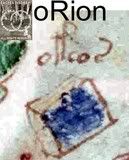
First up: the EVA fragment "oteos" by the curious box at the top of f102v2 (above, with and without blue paint) is claimed to represent "The Orion Cube (Yellow Book)", though I have to say it looks a bit like a pop-up toaster to me. The claim is that, if you look really carefully (the hypnotic trick phrase used by all secret visual histories), the two tiny dots above the "c"-shaped letter ~kind of~ turn the gallows character into a "R", which ~if you squint a bit~ makes the word look like "Orion". (And, of course, there is that whole modern Hancock / Bauval mythology about Orion and the pyramids to tap into). Probably nonsense, but all the same, hurray! Someone is bothering to look really closely at the VMs! :-)

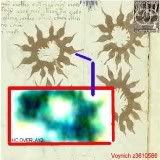
Next: a picture that supposedly details "Lotus Research" in the Voynich Manuscript. According to Caspa here, "the inset is a photograph taken through Dan's microscope of a DNA swirl from Lotus. The background is from the Voynich manuscript." (Actually, it's f16v with red muted). Errrm... is this saying that Roger Bacon had a microscope? Wasn't that refuted 75 years ago?

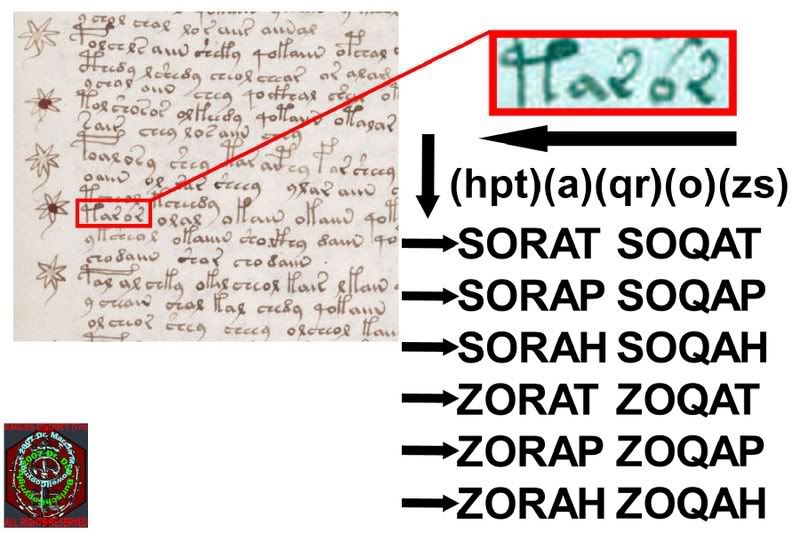
Finally: another picture picking out the EVA word "taror" from f107r, which apparently encodes (reading right-to-left) to the word-pattern "[s/z].[o].[q/r].[a].[p/t/h]", i.e. perm any 1 of 2x2x3=12 to find the word you want (sorap? zoqah? etc). Well... Dan Burisch posted just now that the right answer is neither Sorat (as per this page, scroll-down to "Sorat" and "Sorat-Science"), nor Sorah, nor Zorah: but instead "none of them". Apparently, this is because "this book should never have been written, as its writer supposed the future was to be 'as such' before it happened. " And that, Burisch says, is "a no, no!" Of course it is - bless his tangled little tenses.

If you still want to read more (which is possible, but perhaps a little unlikely), there's an additional post here which may or may not answer all your Voynich-related questions about Burisch, J-Rods etc etc.

UPDATE: More Dan Burisch Voynichification...